
Plinko Strategy Australia: 10 Rules Tested
We recorded 3,000 Plinko demo drops and replayed ten staking rules. One setting found on the complete Normal-risk history finished +2,175.4 FUN; a separately fitted rule lost on the split check. See the exact steps and graphs, then change the settings in the free simulator. All results use virtual credits, not money.
Original international FUN demo · independent editorial study · no real-money account test

A strategy changes the stake.
See what that changes.
Choose a task, follow the exact rule and inspect the resulting bank path. A profitable replay is something to examine, not a promise.
Learn the ten systems
Start with the exact stake sequence, the reset rule and a graph for each approach.
Explore 10 strategies →Make your own comparison
Change the bank, cap and stopping rules; replay recorded pockets or generate clearly labelled practice.
Explore Simulator →Inspect the historical fits
See which centre-count parameters finished ahead and how a separate split check behaved.
Explore Test results →A rule found on this history
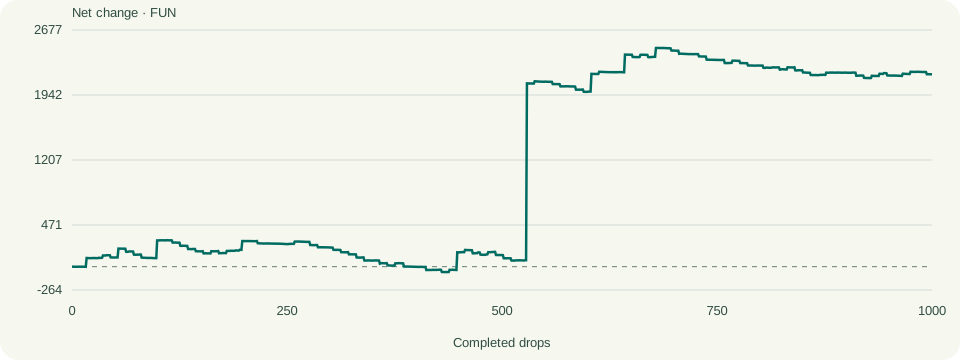
Normal risk, 1,000 recorded pockets. This setting was selected after seeing the complete sample.
Centre-count rule
Count centre pockets in the previous paid drops, then conditionally raise the next stake.
The graph uses mathematical stake amounts. Exact doubles and percentage stakes may be absent from the game’s buttons; choose demo amounts in the simulator to compare the adjusted version.
Exactly what to do on each drop
- Use 1 FUN on ordinary drops. Count the centre pocket (index 8, ninth from the left) in the previous 16 completed paid drops.
- If that count is at most 4, put a total stake of 50 FUN on the next drop. This is the entire stake, not 50 times a separate stake.
- After a raised bet, place 8 paid drops at 1 FUN before checking again. Every completed drop stays in the rolling history.
- Stop before the required stake exceeds 100 FUN or the remaining bank. These parameters were selected after examining all 1,000 results.
See all three risks, baseline strategies and the 600/400 split check →
Choose a Strategy by the Decision It Changes
A Plinko strategy is only ever a rule about your next stake. It cannot move the ball, and it cannot change the payout table. Once you accept that, choosing between systems becomes much simpler: you are really choosing how your bet size reacts to wins and losses, and how much swing you can tolerate.
Flat betting keeps every drop identical, which makes results easy to read and losses slow. Percentage staking scales the bet to your bank, so stakes shrink after losses but balloon after wins. Martingale doubles after a net loss and resets after a win; in our high-risk replay it hit the 100 FUN stake cap after just 29 drops. D’Alembert and Fibonacci climb more gently but still ran into the cap or an empty bank on volatile settings. Paroli and 1-3-2-6 press wins instead of chasing losses, while stop-limit rules simply pause play when a cycle swings 20 FUN either way.
None of these alter the underlying return. Across our low-risk replays, every completed system finished between roughly 96.7% and 97.7% RTP, clustered around the flat-bet result of 97.05%. What changes is the path: drawdown ranged from 31.3 FUN flat to 145.6 FUN under percentage staking. Pick the rule whose worst-case path you can genuinely afford, and read the full mechanics on our strategy breakdowns before committing.
Learn the Controls Before You Test Anything
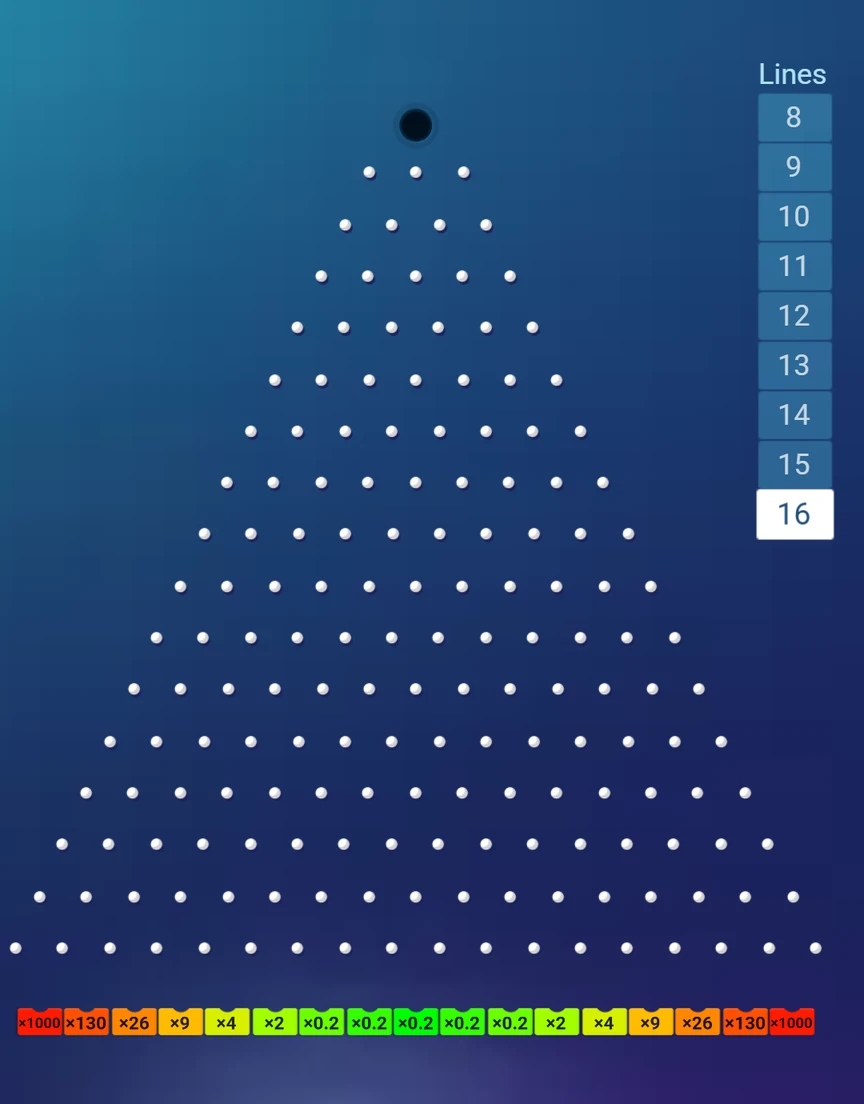
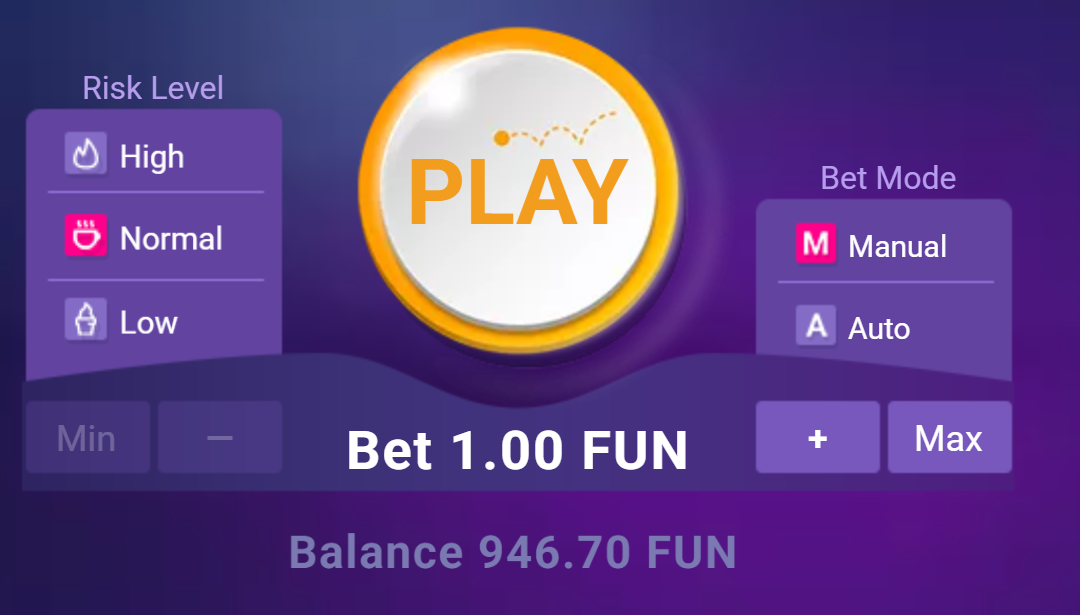
BGaming Original Plinko gives you four real levers. Lines selects the row count from 8 to 16; our research fixes 16 rows so every result is comparable. Risk Level switches between Low, Normal and High, which changes the payout multipliers but not the ball's path probabilities. The bet stake adjusts with minus and plus buttons or Min and Max shortcuts, and Bet Mode toggles between Manual drops and Auto play.
Auto mode exposes a number-of-bets count and a Stop button, but we did not observe native stop-loss or take-profit controls, so any limit discipline has to come from you. One quirk worth knowing: several moving balls on screen can be separate, already-settled drops, and the animation may lag behind your balance. Trust the balance, not the balls.
Settlement is simple arithmetic. Stake multiplied by the pocket multiplier equals the payout, and payout minus stake is your net result. A 2 FUN drop landing on 0.5x returns 1 FUN for a 1 FUN loss; the same stake on 9x returns 18 FUN for a 16 FUN profit. If you are new to the board, the how to play guide walks through each control in order.
One round, three numbers
A 2 FUN stake at 0.5× returns 1 FUN. The net is −1 FUN. At 9×, the same stake returns 18 FUN: +16 FUN net.
Read the illustrated rulesTry the Plan Before Increasing the Stake
Every figure on this site comes from FUN virtual credits, where 100 minor units make one credit and nothing has cash value. That is deliberate. Free play lets you watch a strategy fail cheaply, and most strategies do fail eventually.
A sensible testing routine looks like this. Set 16 rows and one risk level. Run at least 100 manual drops at a flat 1 FUN stake and note your net result and worst drawdown. Then replay the same stretch with your chosen staking rule in the free Plinko simulator and compare the two paths. If the staking rule only looks better because one lucky 26x landed during a raised stake, you have learned something important about variance rather than discovered an edge.
Forum questions we see internationally, like doubling stakes after 25 low 0.2x returns in 30 drops or tapping five to eight times in a row, are variations on the same impulse: reacting to a short streak. Our data treats every drop as independent, so a run of low pockets tells you nothing about the next one. Test the idea free, watch it behave over hundreds of drops, and only then decide whether it deserves a real stake anywhere. The free demo is the fastest place to start.

Open the Plinko demo
Loads the external BGaming demo only after you press the button. FUN credits cannot be withdrawn.
If embedding fails, open the official public demo in a new tab. A working demo does not establish real-money availability in Australia.
Understand the Board and What 3,000 Drops Show
At 16 rows the ball's path follows a binomial distribution across 17 pockets. The centre pocket holds a 19.64% chance on every drop, while either extreme edge sits at 1 in 32,768. Low, Normal and High risk share this exact landing pattern; only the multipliers change. Theoretical return is 99.00% on Low, 98.99% on Normal and 98.98% on High, so the house edge is near-identical and risk selection is really a volatility choice.
Our measured runs matched that picture. Low risk returned 97.05% over 1,000 drops with a longest losing streak of four. Normal returned 101.94%, helped by a single 41x hit. High returned 95.74% with a 24-drop losing streak and a 157.6 FUN drawdown, despite offering the 1000x headline multiplier that has about a 3% chance of appearing even once in 1,000 drops.
The most tempting result in our testing came from a centre-count rule that raised stakes after centre-heavy windows. Fitted across a full 1,000 high-risk drops it showed a 4,367.4 FUN profit, but that is retrospective curve-fitting: the rule was chosen because it won on that exact data. Frozen on its first 600 drops and checked on the final 400 with a fresh bank, the same family of rules produced +224 FUN on high risk but a 974.8 FUN loss on Normal, ending with insufficient balance. Positive historical examples are real, and so are the reversals. The full numbers live on the results page and the odds breakdown explains the maths behind every pocket.
Australian Access and App Checks
Australian readers should know the local frame before going beyond free play. The ACMA lists online casinos among the services that are illegal for providers to offer to people in Australia, and prohibited services cannot be advertised here. That is why this site tests everything in FUN credits and does not promote or link to any real-money operator.
Be equally careful with mobile apps. The ACCC says games and their advertising must not mislead about features, price or subscriptions, and the app stores carry everything from genuinely free virtual-only Plinko games to ad-reward apps and fronts for funded casino products. Check what an app actually pays out, if anything, before handing over details or money. Our Plinko apps guide separates the categories so you can tell a free simulator from something asking for a deposit.
Plinko strategy questions
What is the best Plinko strategy?
No staking strategy changes Plinko's odds, because each drop is independent and the payout table is fixed. In our 3,000 recorded drops, flat betting was the easiest system to manage, while aggressive progressions like Martingale and D’Alembert hit stake caps or emptied the bank on higher risk settings. The best practical approach is flat or small-percentage staking at a risk level whose drawdowns you can afford.
Does changing risk level change where the ball lands?
No. At 16 rows, Low, Normal and High risk share the identical binomial landing probabilities: 19.64% for the centre pocket and 1 in 32,768 for either edge. Only the multipliers change, which is why theoretical RTP stays near 99% on all three while volatility rises sharply.
Can a backtested Plinko system predict future wins?
No. Our best-performing centre-count rule showed a 4,367.4 FUN profit when fitted to the full 1,000 high-risk drops it was selected on, but that is retrospective fitting. Checked on held-out drops with a fresh bank, the same rule family lost 974.8 FUN on Normal risk. Past results, seed hashes and streaks do not predict the next pocket.
Is online Plinko legal in Australia?
The ACMA lists online casinos among services illegal for providers to offer to people in Australia, and prohibited services cannot be advertised here. Free virtual-credit play, like the FUN simulator on this site, involves no money at all. We do not promote or verify any real-money operator.
How many drops should I test before trusting a strategy?
Far more than most people expect. Our 1,000-drop runs still swung several percentage points around the theoretical return, and a 1000x top multiplier has only about a 3% chance of appearing even once in 1,000 drops. Treat anything under a few hundred drops as noise, and always compare a staking rule against flat betting on the same outcomes.