
BGaming's Original Plinko looks simple: a ball falls through a pyramid of pegs and lands in a pocket with a multiplier. Underneath that simplicity sit three decisions you control before every drop: how many rows, which risk level, and how much to stake. This guide walks through the screen, the settlement maths, and a structured set of ten practice drops in FUN virtual credits, so you understand exactly what each control does before you experiment with settings or staking patterns. Everything here uses the official 16-row configuration and verified payout tables.
Identify the game and read the screen
Before anything else, confirm you are looking at BGaming's Original Plinko. The name 'Plinko' is shared by Plinko 2, Stake's version, Hacksaw's variant, arcade machines and the television board, and their payout tables and controls differ. This guide covers only the BGaming original, where the official rules and current interface allow 8 to 16 rows. For consistency, every number in this article uses 16 rows, which is the configuration this project's research fixes deliberately.
The play area shows a triangular field of pegs with a row of pockets along the bottom. Each pocket carries a multiplier, and the multipliers are symmetric: the same values appear mirrored left and right, rising toward the outer edges. Above or beside the board you will find the Lines selector (the row count), the Risk Level control offering Low, Normal and High, the Bet stake field with minus and plus buttons plus Min and Max shortcuts, and the Bet Mode toggle between Manual and Auto.
The balance display is denominated in FUN virtual credits, where 100 minor units make one credit. FUN is not AUD and has no cash value; it exists so you can learn the mechanics without financial exposure. One interface quirk worth knowing early: if you fire off several drops quickly, multiple balls can be moving at once, and those balls may represent drops that have already been settled in the ledger. The animation can lag behind the balance, so always read the settled balance rather than judging results by where balls appear to be on screen.
What the three risk levels actually change
Risk Level swaps the payout table, not the physics. At 16 rows the ball's path follows the same landing distribution on every setting; Low, Normal and High only change what each pocket pays. Low tops out at 16x with a gentle 0.5x centre. Normal reaches 110x with a 0.3x centre. High reaches 1000x but pays just 0.2x across a wide band of central pockets. Choosing a risk level is choosing a shape of outcomes, which the best settings guide explores in detail.
Set up and complete one drop
A single drop takes four deliberate actions. First, set Lines to 16 so your results match the tables in this guide. Second, choose a Risk Level; Normal is a sensible starting point because its table shows both meaningful losses and meaningful wins without the extreme droughts of High. Third, set your stake with the minus and plus buttons, or tap Min to drop to the smallest stake. Fourth, with Bet Mode on Manual, press Play once.
The ball releases from the top, ricochets through the pegs, and settles into one of 17 pockets. The game credits stake multiplied by the pocket multiplier immediately, and your balance updates even if the ball animation is still finishing. That is one complete drop: stake committed, pocket determined, payout settled.
Resist the urge to change three things at once while learning. If you alter rows, risk and stake simultaneously, you cannot tell which change caused a different feel in your results. Hold rows and risk constant for your first session, vary only what you are deliberately testing, and keep a rough note of outcomes. The free demo is the right place for this because every drop costs virtual credits only.
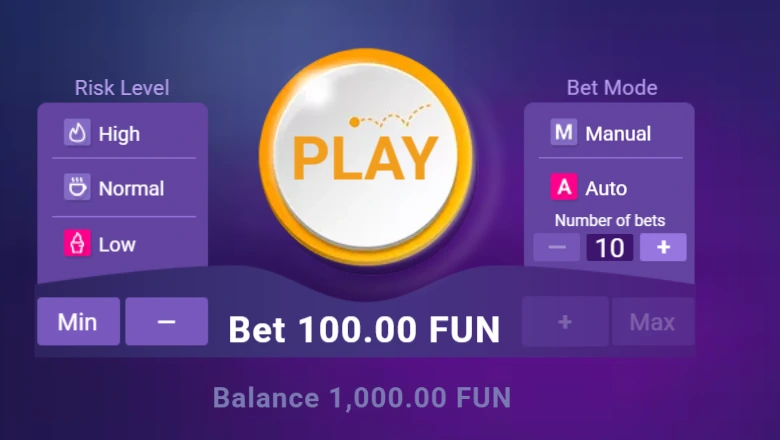
Can you choose that stake in the game?
The amount buttons matter when you take a rule out of a spreadsheet. In our FUN interface, successive plus presses select 1, 2, 3, 5, 10, 15, 20, 30, 50, 75 and 100. A request for 4 FUN therefore cannot be followed literally with these buttons. The collected study used 1 FUN throughout, so its observed returns are unaffected.
Our original charts calculate ideal stake amounts to cents. The simulator now also has a demo-button option: it checks the minimum and cap first, then lowers an allowed request to the nearest available amount. For instance, a request for 8 becomes 5 FUN. That is a changed progression, so compare its new curve rather than treating it as an exact Martingale. Percentage stakes stop below the 1 FUN minimum. The selected full-history centre rules use 1 and 50 FUN, both available amounts.
- Set Lines to 16 rows.
- Choose Risk Level: Low, Normal or High.
- Enter a stake using minus/plus, Min or Max.
- Confirm Bet Mode is Manual.
- Press Play once and watch the pocket the ball lands in.
- Read the multiplier, then check the settled balance, not the animation.

Calculate payout and net profit
Settlement uses one formula: stake multiplied by the pocket multiplier equals the payout returned to your balance. Net profit is the payout minus the stake. A multiplier below 1.0 means you get some credits back but still lose on the drop; a multiplier of exactly 1.0 is break-even; anything above 1.0 is profit.
Two worked examples from the actual 16-row Low table. Stake 2 FUN and land on 0.5x: the payout is 2 × 0.5 = 1 FUN returned, so your net result is −1 FUN. Stake 2 FUN and land on 9x: the payout is 2 × 9 = 18 FUN returned, a net of +16 FUN. Notice that a 'win' in animation terms (credits come back) can still be a net loss, which is why tracking net rather than returned credits matters.
The three risk tables at 16 rows show how the same ball path produces different settlement shapes. On Low, the multipliers run from 16 at the edges down to 0.5 at the centre, and about 45.45% of drops finish in profit while 19.64% lose. On Normal, multipliers run from 110 down to 0.3, profit probability falls to about 21.01%, and 54.55% of drops lose. On High, the edge pockets pay 1000x but 78.99% of drops lose, with no exact break-even pocket at all.
Each table's theoretical return sits just under 99%: 98.9987% on Low, 98.9883% on Normal and 98.9764% on High at this configuration. Those are long-run averages, not promises for a session. The standard deviation tells the real story of feel: 0.33 on Low, 1.47 on Normal and 6.57 on High, measured in stake units. High risk is roughly twenty times as swingy as Low per drop, which is exactly what you will experience as long losing runs punctuated by rare large hits.
| Risk | Edge multiplier | Centre multiplier | Profit chance | Loss chance | Theoretical RTP |
|---|---|---|---|---|---|
| Low | 16x | 0.5x | 45.45% | 19.64% | 98.9987% |
| Normal | 110x | 0.3x | 21.01% | 54.55% | 98.9883% |
| High | 1000x | 0.2x | 21.01% | 78.99% | 98.9764% |
Work through ten practice drops
A structured first session teaches more than random clicking. Use a 1000 FUN practice bank and a flat 1 FUN stake on Normal risk at 16 rows. Flat staking means the same stake every drop regardless of outcomes; it is the baseline against which every fancier staking pattern is measured, and it keeps your arithmetic clean.
Drop one: just watch. Note the pocket index counting from the left edge as 0 through 16, and the multiplier. Drops two to five: after each, write down payout and net using the formula from the previous section. Drops six to ten: predict before each drop which outcome is most likely. The centre pocket (index 8) is the single most probable landing spot at 19.638%, and the distribution is bell-shaped, so most balls finish near the middle where Normal pays 0.3x to 1.5x.
After ten drops, total your net. Expect it to be negative more often than not; ten drops is far too small a sample for the 98.99% theoretical return to assert itself. The point of the exercise is fluency: reading pockets, computing net, and feeling the pace of the game. International forum players often describe tapping five to eight times rapidly or reacting to short streaks; treat those as habits people report, not proven methods, because each drop is independent of the last.
If you want to go further, the Plinko simulator replays staking rules mechanically over long runs, and the results tool shows verified outcomes from this project's own test collection as it completes. Historical configurations there are things to evaluate, not a promise of future advantage.
- Start with 1000 FUN, 16 rows, Normal risk, 1 FUN flat stake.
- Drop once and record pocket index and multiplier.
- For drops two to five, calculate payout and net by hand.
- For drops six to ten, predict the likely region before releasing.
- Total your net after ten drops and compare it with the theoretical return.
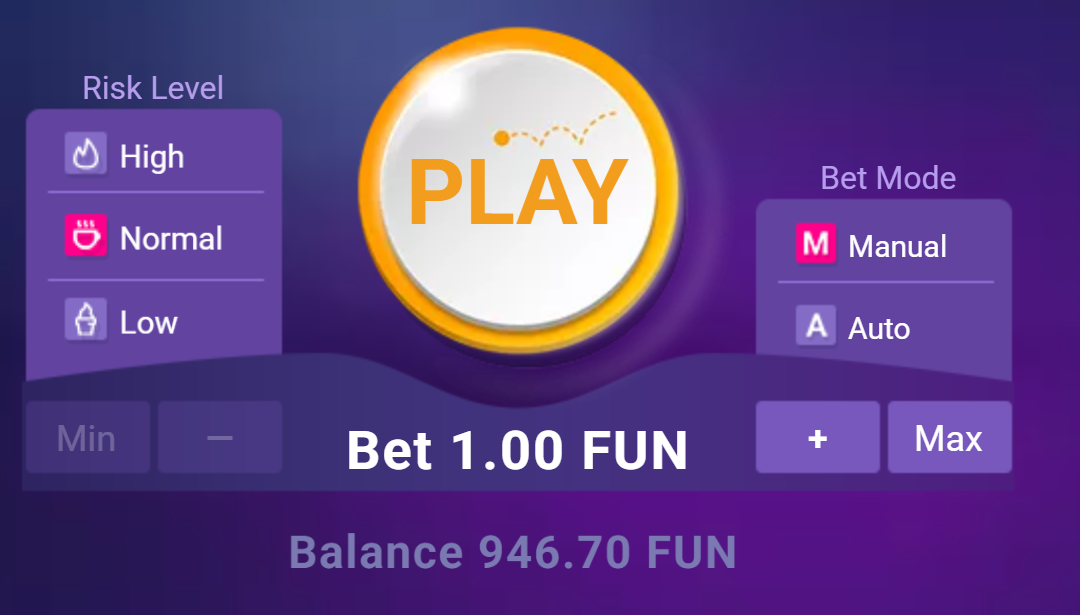
Manual play, Auto and mobile controls
Manual mode is one press, one drop. It suits learning because you can pause between drops, check the settled balance and think. Auto mode runs a sequence for you: you set the stake as usual, expose a number-of-bets count, start the run, and a Stop control lets you halt it early. This guide does not claim native stop-loss or take-profit controls were observed in the interface, so if you want loss or win limits you must enforce them yourself by watching the balance and pressing Stop.
Auto changes speed, not odds. Every drop in an Auto run is an independent event with the same distribution as a Manual drop at the same settings. The practical risks are pace and attention: twenty Auto drops can settle in the time one Manual drop takes to watch, and the animation lag means your eyes may be several drops behind the ledger. Set a modest bet count, keep the stake small, and check the balance when the run ends.
On mobile the same controls are rearranged for touch: Lines, Risk Level, stake buttons and the Play button all sit within thumb reach, and rapid tapping can queue multiple drops quickly. Remember that several moving balls can be separate already-settled drops, so a flurry of taps spends credits faster than the visuals suggest. If you are comparing free virtual play, ad-reward apps and funded casino products on your phone, the Plinko apps guide separates those categories properly.
Separate casino Plinko from arcade and television boards
The name causes real confusion. The television version is a game-show segment where a contestant earns chips and drops them for prizes; there is no stake, no risk setting and no payout table you control. Arcade and redemption versions are physical machines with mechanical randomness and ticket prizes. BGaming's Plinko is a software game with a defined probability model, configurable rows and risk, and credit-based settlement. Strategy discussion that works for one format is meaningless for another.
In this digital version the 16-row landing distribution is Binomial(16, 0.5): at each of 16 peg rows the ball effectively goes left or right with equal chance, producing 17 pockets indexed 0 to 16. The centre pocket's probability is C(16,8)/65536 = 19.638%, while either extreme edge pocket lands just 1 in 65536 drops, and the two edges combined 2 in 65536. It is a bell-shaped binomial, not an exact continuous normal curve, and the normal approximation is poor in the rare tails where the big multipliers live.
Independence matters for how you interpret streaks. Past outcomes do not make the next pocket predictable, and a seed hash shown after the fact is not the unrevealed seed or a forward prediction. Long droughts without a 1000x hit are normal on High risk, not evidence the game is due. For the full mathematics, see the Plinko odds breakdown, and treat any predictor tool claims with the scepticism they deserve given independence.
One local note for Australian readers: the ACMA's current official page (21 August 2026) lists online casinos among the services illegal for providers to offer to people in Australia, and prohibited services cannot be advertised here. The ACCC also requires that mobile games and their advertising not mislead about features, price or subscriptions. None of that makes every Plinko app gambling, and this article's FUN-credit practice involves no money at all; just be clear about which category of product you are using before you fund anything.
Questions about Plinko
What is the best risk level for a beginner in Plinko?
Start on Normal at 16 rows. It shows real wins and real losses without High's 78.99% loss rate, and its 1.47 standard deviation is manageable. Move to Low if you want gentler swings while learning the controls.
How is a Plinko payout calculated?
Payout equals stake times the pocket multiplier, and net profit is payout minus stake. For example, 2 FUN at 0.5x returns 1 FUN for a −1 FUN net, while 2 FUN at 9x returns 18 FUN for a +16 FUN net.
Does Auto mode change my chances of winning?
No. Auto only speeds up play by running a set number of bets at your chosen stake. Every drop remains independent with the same binomial distribution as Manual play at identical rows and risk settings.
Can I predict where the Plinko ball will land next?
No. Drops are independent, so past pockets carry no information about the next one. A seed hash revealed after a drop is not the unrevealed seed and cannot predict future outcomes.
Is the centre pocket really the most likely landing spot?
Yes. At 16 rows the centre pocket (index 8) has probability C(16,8)/65536 = 19.638%, the highest of all 17 pockets. The distribution is bell-shaped, so central pockets collectively absorb most drops.
Is Plinko with FUN credits the same as real-money play?
Mechanically yes, financially no. FUN credits use 100 minor units per credit and have no cash value, so you can learn rows, risk and settlement without spending anything. Funded casino products are a separate category with different stakes and rules.