
Search for a Plinko predictor and you will find APK downloads, Telegram signal sellers and forum threads about tapping five to eight times or changing the seed after a cold streak. None of these can see the next result in BGaming Original Plinko, because each drop is generated independently. What you can do is something more useful: turn your own pattern idea into a testable staking rule, run it on the free demo, and check it honestly on data it has never seen. This guide walks through that whole process, from writing the rule to reading the results without fooling yourself.
Try a rule, not a signal: open the practice simulator, choose “Centre-count rule”, and see exactly which paid drops trigger a different stake. No account or predictor APK is required.
A predictor cannot reveal an unknown next result
Every drop in this game is modelled as an independent event. The ball's path through 16 rows of pins is a sequence of left-or-right bounces, which is why the landing pockets follow a Binomial(16, 0.5) distribution across 17 pockets, indexed 0 to 16. The centre pocket (index 8) lands with probability C(16,8)/65536 = 19.638%, while either extreme edge lands only 2 times in 65,536 drops. That vector is fixed by the maths of the board. Switching between Low, Normal and High risk changes the payout multipliers attached to each pocket, but it does not change the landing probabilities at all.
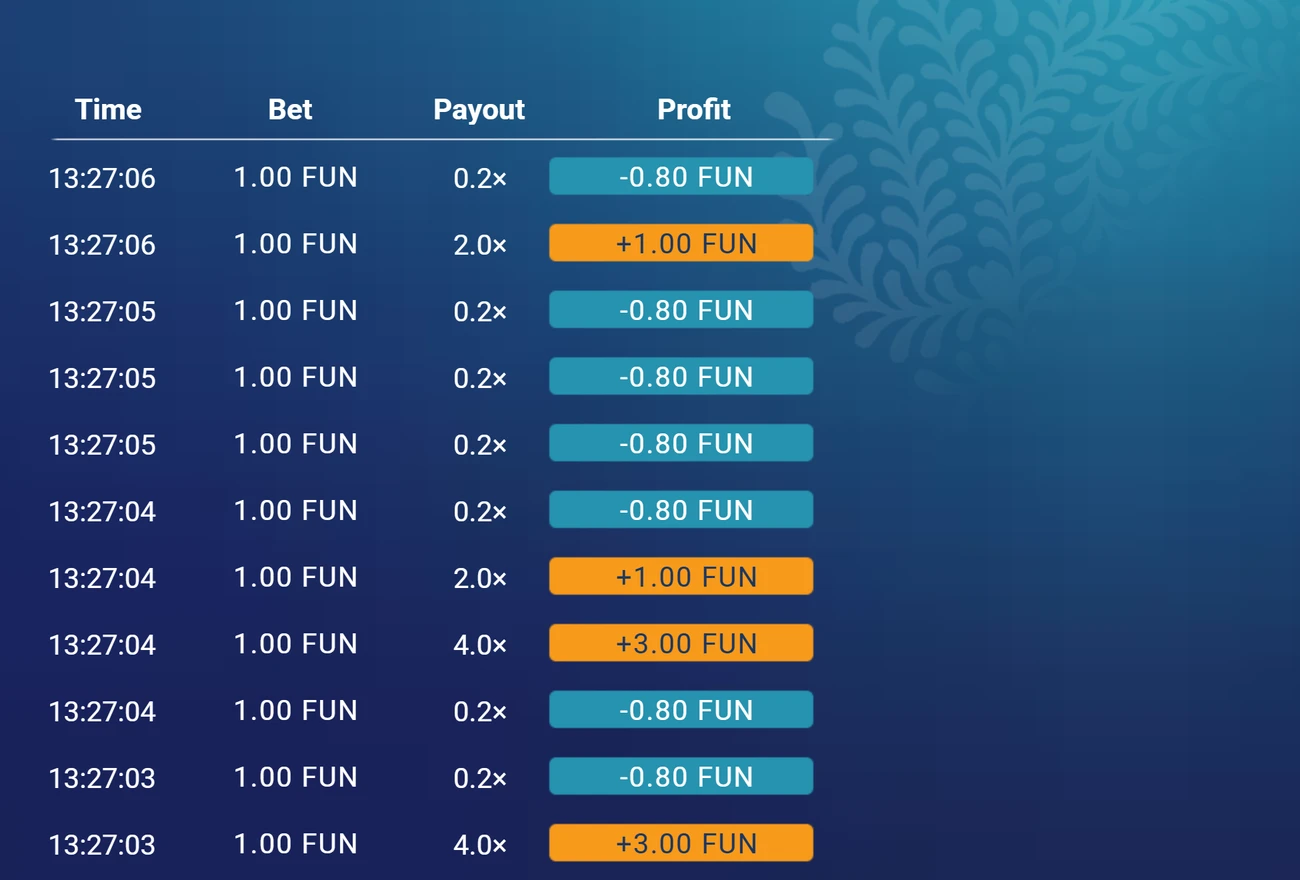
Independence is the part predictor sellers hope you skip. Because drops are independent, the previous 25 low 0.2x returns in 30 drops — a pattern real players on international forums have asked about — tell you nothing about drop 31. The probability of the next pocket is the same whether you just hit 1000x or just watched a long drought without one. A bell-shaped binomial spread also means streaks and clusters happen naturally; they are not signals, they are what randomness looks like up close.
The seed question deserves a direct answer too. Provably fair systems show you a hash of the server seed before you play, so you can verify afterwards that the result matched a committed value. That hash is not the unrevealed seed, and it is not a forward prediction. Changing your client seed, as some forum posts suggest, reshuffles which random values you draw next, but it cannot make those values favourable. An app claiming to decode the hash into the next pocket is claiming to break the cryptographic commitment the fairness system is built on — which is a strong sign the claim is false.
What a real edge would require
To genuinely predict Plinko you would need the unrevealed server seed and the exact algorithm before the drop, which the operator never exposes. Anything short of that — pattern reading, timing taps, seed switching — is guessing dressed up as method. That is why this page focuses on testing staking rules rather than finding signals: staking rules are honest about what they can and cannot change.
Turn a vague pattern into a testable rule
A hunch like "bet bigger after a cold streak" is untestable because it never says how much bigger, after how many losses, or when to stop. A testable rule specifies four things: the base stake, the trigger that changes it, the size of the change, and the reset condition. For example: "Flat 1 FUN per drop, except raise the next stake by 4 FUN when the previous rolling window of paid drops produced a centre-pocket count above my threshold; return to base afterwards." That is precise enough to replay mechanically, which is how the rules in our Plinko simulator are defined.
It helps to see how the classic staking systems look when written this precisely. A martingale doubles the stake on a net loss, resets on a net win, and leaves the stake unchanged on a break-even drop. A capped martingale follows 1-2-4-8-16 and resets after a loss at 16. D’Alembert adds one base unit after a loss and subtracts one after a win, never going below one. Fibonacci starts 1, 1, 2, 3 and advances one step after a net loss, back two after a win. Paroli doubles after a net win for up to three wins, then resets. The 1–3–2–6 sequence progresses through successive net wins and resets after any loss. Each is fully mechanical — no judgement calls mid-run.
Settlement maths is what makes a rule checkable. Payout equals stake times multiplier, and net equals payout minus stake. So 2 FUN at 0.5x returns 1 FUN for a net of −1 FUN, while 2 FUN at 9x returns 18 FUN for +16 FUN net. On High risk at 16 rows, pockets paying 0.2x mean a "win animation" can still be a net loss, which is why rules here trigger on net result, not on whether any money came back. Keep your rule in FUN virtual credits — the demo currency, at 100 minor units per credit — so nothing in your test pretends to be real money.
Guards every rule needs
Two guards keep a test honest: a stake cap (our replay uses 100 FUN) and a remaining-bank check before every bet. If a rule cannot afford its next stake, the run stops — the stake is never silently clipped to fit, because clipping would hide the moment the strategy actually broke. Default test conditions are a 1000 FUN bank and a 1 FUN base, which keeps different rules comparable.
- Write the base stake and bet mode (Manual or Auto) you will use.
- Define the trigger in numbers: which window, which count, which threshold.
- Define the stake change as an absolute amount or multiplier, and the reset condition.
- Add a stake cap and a bank check, and state what happens when the next bet is infeasible.
- Write the rule down before you touch the demo — no editing mid-session.

Practise the rule manually
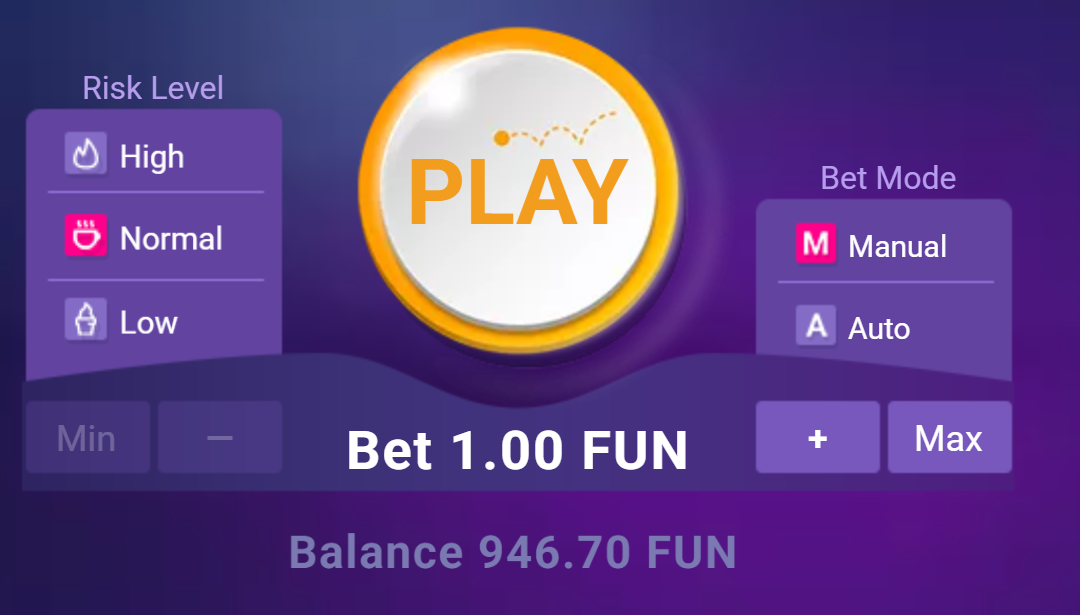
Before automating anything, run your rule by hand on the free Plinko demo in Manual bet mode. Set Lines to 16 with the Lines control — the official rules allow 8 to 16 rows, but fixing 16 keeps your test aligned with the probability vector above — and pick one Risk Level (Low, Normal, or High, labelled medium in the underlying wiring) and keep it for the whole session. Use the minus and plus buttons or Min/Max to set stakes, and record each drop's stake, multiplier and net in a simple spreadsheet.
Manual practice exposes the flaws in a rule faster than any theory. You will quickly feel how often High risk pays 0.2x — the loss probability there is 0.789886 per drop, with a break-even probability of exactly 0, because no pocket returns precisely your stake. On Low risk, by contrast, the profit probability is 0.454498 and losses are only 0.196381 of drops, but the standard deviation is just 0.3319193191214202 times your stake, so even a martingale escalates slowly. Medium sits between: over half of drops (0.545502) lose, with a standard deviation of 1.4672407092599933.
Watch the interface quirks while you practise. Multiple moving balls on screen can be separate, already-settled drops, and the animation may lag behind your balance updates — so always score a drop from the balance change and payout figure, not from where a ball appears to be sitting. If you switch to Auto mode to speed things up, note that it exposes a number-of-bets count and a Stop control; native stop-loss or take-profit controls were not observed, so any stop rule has to be yours, enforced by you.
- Open the demo, set Lines to 16 and choose one Risk Level.
- Set your base stake with the minus/plus controls and play Manual.
- Log stake, multiplier, payout and net for every drop.
- Apply your rule's trigger strictly, even when it feels wrong.
- After 50–100 drops, check whether you actually followed the rule as written.
Separate fitting from a fresh-data check
Fitting and checking must happen on different data. If you search a full sample of drops for the threshold that would have made your rule look best, you are doing retrospective fitting — the rule has already seen the data, so its performance on that same data proves nothing. A rule tuned to the first 600 rows of a 1000-drop set can be frozen and then evaluated on the last 400 rows; that second block is a genuine held-out check. A best fit chosen using all 1000 rows is not held-out, no matter how good it looks.
Our centre-count rule uses paid drops in a rolling window. When that window contains at most the chosen number of centre landings, the next total stake is raised to a specified amount. The cooldown consists of paid base-stake drops, which still update the history. We recorded 3,000 demo drops, 1,000 per risk, and excluded ten setup drops. The completed results separate settings selected on all 1,000 rows from a second search on the first 600 and a check on the remaining 400. The latter starts with a fresh comparison bank and empty history. Both analyses use the same recorded study; neither is a prospectively registered future trial.
You can run the same discipline yourself. Split your logged session in half chronologically. Tune on the first half only — pick your window length, threshold and boost size. Freeze the rule, write it down, then score it on the second half with zero adjustments. If the edge vanishes on fresh data, the rule was fitted to noise. Given that the theoretical RTP of every risk level sits just under 99% — 98.999% on Low, 98.988% on Medium, 98.976% on High — the expected value of any staking pattern stays negative; what honest testing tells you is how a rule reshapes variance, drawdowns and session length, not how to beat the margin.
Reading the results charts
When the results tool renders its charts, read the horizontal axis as the drop sequence and the vertical axis as bank or net position, and compare each rule's curve against the flat-stake baseline rather than against zero. Look for maximum drawdown, how often the stake cap or bank check forced a stop, and whether a rule's apparent edge survives the held-out block. A curve that only wins in its fitting window is a fitted artefact, not a finding.
- Split your logged drops into an earlier fitting block and a later check block.
- Tune all parameters on the fitting block only.
- Freeze the rule in writing.
- Score it on the check block with no changes.
- Compare against flat staking on the same block, and report both honestly.
Read a seed claim and a suspicious app offer
A typical predictor offer claims the app reads the server seed hash and outputs the next pocket, often bundled as an APK download outside official app stores. You now know why that fails on its own terms: the hash is a commitment you verify after the drop, not the seed itself, and drops are independent anyway. An APK that genuinely could do this would be claiming to defeat the cryptography of the fairness system — and if someone had that, they would not be selling it in a Telegram channel.
There is also a plain consumer angle. The ACCC says mobile games and their advertising must not mislead about features, price or subscriptions, and a paid "predictor" that cannot predict anything is squarely in misleading-feature territory. Be equally careful to distinguish three very different products that all get called "Plinko apps": free virtual-only play like the FUN-credit demo this site documents, ad-reward apps that pay for watching advertising, and funded casino products. On that last category, the ACMA's current official page lists online casinos among the services it is illegal for providers to offer to people in Australia, and prohibited services cannot be advertised here. Our Plinko apps guide goes deeper on telling these apart; the short version is that a signal-selling APK combines unverified software, a false claim and often a subscription.
Forum folklore deserves the same clear-eyed reading. Tapping five to eight times, changing the seed after a drought, or raising stakes after 25 low returns are real questions international players ask, but none of them are proven winning methods, and none change the binomial vector. If a claim cannot be written as a testable rule and checked on held-out data, it belongs in the bin, not in your staking plan.
Review the results without chasing a recovery
When your test ends, review it like an auditor. Compare the rule against flat staking on the same drops: total net, maximum drawdown, number of times the stake cap or bank check stopped the run, and how long the bank lasted. Stop-limit style rules — flat stakes that pause when cycle net reaches ≤−20 or ≥+20, or restart versions that resume immediately using the remaining bank — are useful comparators because they show what disciplined stopping looks like, but note that in the restart version combined losses are never erased; pausing does not refund anything.
The most dangerous moment in this whole process is a losing held-out result, because the temptation is to re-tune and re-test until the rule "works". That is just fitting again with extra steps, and it is how recovery-chasing starts: the rule becomes a story about getting back to even. With every risk level returning a mean of roughly 0.9898 to 0.9900 times stake per drop, no staking sequence turns the expectation positive — martingale and its cousins only concentrate losses into rarer, larger hits, which is exactly why the 100 FUN cap and infeasible-bet stop exist in the replay protocol.
The healthy endpoint is a written conclusion: what the rule did to variance, where it broke, and whether you would stake real money on it — which, for Australian readers, is not something this site facilitates anyway, since the demo runs on FUN virtual credits with no cash value. If you want to keep exploring, compare risk levels on the Plinko odds page, browse structured approaches on the strategies page, or revisit best settings for row and risk combinations. Treat every future claim — yours or an app's — to the same standard: a written rule, a fitting block, a frozen test, and a fresh-data check.
- Score total net, max drawdown and stops for rule and flat baseline.
- Write one sentence on what the rule changed and one on where it failed.
- Decide in advance what result would make you abandon the rule — then honour it.
- Never re-tune on the check block; start a new experiment with new data instead.
Questions about Plinko
Is there a working Plinko predictor APK?
No. Drops are independent and the server seed is never revealed before play, so no app can know the next pocket. A seed hash only lets you verify results afterwards. Predictor APKs make a claim that is mathematically impossible and often add misleading subscriptions on top.
Is Plinko rigged if I keep hitting 0.2x on High risk?
Not necessarily. On High risk at 16 rows, the loss probability per drop is 0.789886 and break-even is exactly 0, so long stretches of 0.2x returns are the expected texture of that mode, not evidence of manipulation.
Does Plinko really pay out?
In the FUN-credit demo documented here, payouts settle mechanically as stake times multiplier every drop, but those credits have no cash value. This project does not verify real-money withdrawals, and online casinos cannot legally be offered to people in Australia.
Does changing the seed improve my results?
No. Changing the client seed changes which random values you draw next, but every value comes from the same fixed binomial distribution. It cannot make future drops more favourable, and the seed hash is never a forward prediction.
What is the most honest way to test a Plinko betting system?
Write the rule mechanically, practise it manually on the demo, tune it on an earlier block of logged drops, freeze it, then score it once on a later block against flat staking. Never re-tune on the check data — that turns testing back into fitting.
Can martingale beat Plinko in the long run?
No. With mean returns around 0.9898 to 0.9900 times stake per drop, martingale only reshapes losses into rarer, larger hits. Stake caps and bank checks exist precisely because doubling eventually hits a bet you cannot place.