
Change the rule. Watch the bank.
This simulator is a testing bench for BGaming Original Plinko, not Plinko 2, Stake, Hacksaw or any arcade or TV board. It runs on FUN virtual credits (100 minor units per credit) with no cash value, so nothing here is gambling for money. The research build deliberately fixes the board at 16 rows, the top of the official 8–16 range, and models drops as independent events on the verified Binomial(16, 0.5) landing vector. You can replay recorded data or generate practice drops, attach a staking rule, and inspect exactly what that rule would have done.
Choose recorded replay or generated practice
Your first decision is where the drops come from. Recorded replay feeds the simulator a fixed sequence of settled outcomes, so every rule you test sees identical balls in identical order. Generated practice creates fresh simulated drops from the same underlying probability model: 17 pockets indexed 0–16, with the centre pocket 8 landing C(16,8)/65536 = 19.638% of the time and a single edge pocket at 1/65536 (both edges combined 2/65536 = 1/32768). Because the vector is bell-shaped binomial rather than a smooth normal curve, rare tails behave worse than a normal approximation suggests, which matters when you judge long droughts.
Replay is the right choice when you want a fair comparison between rules, because the only thing that changes is the staking logic. Generated practice suits open-ended exploration, like watching how a High risk bankroll swings over a few hundred drops. Either way, remember the model assumes independent drops: past outcomes do not make any next pocket more or less likely, and a seed hash is not the unrevealed seed or a forward prediction. If you are new to the underlying game, the how to play guide covers Lines, Risk Level and Bet Mode before you touch the simulator.
Set the rule, bank and limit
Start with the default bank of 1000 FUN and a base stake of 1, then pick one of the ten replay rules. Settlement is always stake × multiplier = payout, and payout − stake = net. So 2 FUN × 0.5 returns 1 FUN for −1 net, while 2 × 9 returns 18 for +16 net. Before any bet is placed the simulator enforces the 100 FUN cap and your remaining bank, and it STOPs before an infeasible bet rather than silently clipping a strategy stake.
The rules, mechanically: fixed bets 1 every drop. Percentage bets 0.5% of bank rounded down to whole 0.01 FUN. Martingale doubles on a net loss, resets on a net win and holds on break-even; capped martingale climbs 1-2-4-8-16 then resets after a loss at 16. D’Alembert adds one base after a loss and subtracts one after a win, minimum 1. Fibonacci starts 1,1,2,3, advancing one step after a net loss and back two after a win. Paroli doubles after a net win for up to three wins then resets. The 1–3–2–6 sequence progresses through successive net wins and resets after a loss. Stop-limits bets flat and pauses when cycle net reaches ≤−20 or ≥+20; restart uses the same thresholds but resumes immediately on the remaining bank, with combined losses never erased.
Risk Level (Low, Normal, High) changes the payout table, not the landing probabilities. Low pays up to 16× with 98.999% theoretical RTP, Normal up to 110× at 98.988%, High up to 1000× at 98.976%. High risk loses on 78.989% of drops, so a small base stake relative to bank is essential if you want a rule to survive long enough to evaluate.
Can you choose that stake in the game?
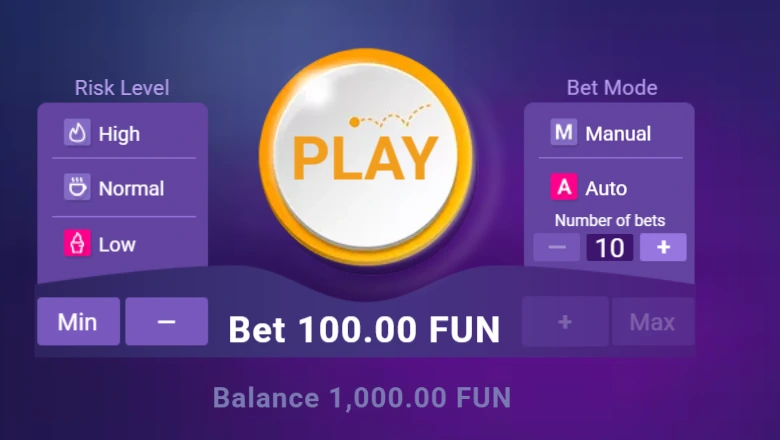
The amount buttons matter when you take a rule out of a spreadsheet. In our FUN interface, successive plus presses select 1, 2, 3, 5, 10, 15, 20, 30, 50, 75 and 100. A request for 4 FUN therefore cannot be followed literally with these buttons. The collected study used 1 FUN throughout, so its observed returns are unaffected.
Our original charts calculate ideal stake amounts to cents. The simulator now also has a demo-button option: it checks the minimum and cap first, then lowers an allowed request to the nearest available amount. For instance, a request for 8 becomes 5 FUN. That is a changed progression, so compare its new curve rather than treating it as an exact Martingale. Percentage stakes stop below the 1 FUN minimum. The selected full-history centre rules use 1 and 50 FUN, both available amounts.
- Leave bank at 1000 FUN and base at 1 for your first run.
- Pick Low risk to learn the log, then rerun on Normal or High.
- Choose one rule only; change one variable per experiment.
- Watch for the STOP state on progression rules near the 100 cap.

Read the graph and trade log
The bank graph plots your FUN balance drop by drop, so the horizontal axis is drop number and the vertical axis is bank. A flat-stake Low risk run drifts gently; a High risk martingale run shows a sawtooth of small recoveries punctuated by deep steps down. The trade log lists each settled drop with stake, multiplier, payout and net, which is where you verify the maths line by line rather than trusting the curve’s vibe.
Multiple moving balls can be separate already-settled drops, and the animation may lag the balance. Always read the log, not the ball positions, when reconciling the graph. If you want context for what the multipliers and pocket odds should look like, the Plinko odds breakdown matches the tables this simulator uses.
Compare two runs fairly
A comparison is only meaningful when both runs face the same drops at the same risk level. Use recorded replay for this: run rule A, then rule B, on the identical sequence, and compare ending bank, deepest drawdown and how often each rule hit the STOP state. Comparing a lucky generated run of one rule against an unlucky generated run of another tells you nothing about the rules.
Be honest about fitting, too. Searching a full sample for the best-looking parameters is retrospective fitting. The defensible approach is to select a rule using the first 600 rows, freeze it, then evaluate on the last 400; an all-1000-row best fit is not held-out evidence. Centre-count boosting — raising the next stake when the previous window’s centre count meets a threshold — can be tested the same way, with the boost as an absolute total stake and paid cooldown drops still spending base stakes. Verified run outputs live in the results tool, where historical configurations are something to evaluate, not a promise of future advantage. For rule ideas, see the strategy overview and best settings guide.
Export a reproducible example
When a run teaches you something, export it so anyone can recreate it exactly. A reproducible example needs the drop source (recorded set or generated seed parameters), row count fixed at 16, Risk Level, starting bank, base stake, the rule and its parameters, and the drop count. With those recorded, another person loading the same inputs gets the same trade log and the same graph, so anyone can check the claim.
Exported examples are also the right way to discuss forum-style ideas — like increasing stakes after 25 low 0.2× returns in 30 drops, or chasing a long 1000× drought. Those are international player questions, not proven methods, and the simulator lets you show mechanically what such a rule does to a 1000 FUN bank instead of arguing from hunches. Share the configuration, not just the screenshot.
Questions about Plinko
Is the Plinko simulator free and does it use real money?
Yes, it is free and runs entirely on FUN virtual credits, with 100 minor units per credit. FUN has no cash value and is not AUD, so nothing in the simulator involves real-money wagering, deposits or withdrawals of any kind.
Does the simulator predict my next Plinko drop?
No. Drops are modelled as independent events on the Binomial(16, 0.5) vector, so past outcomes never change next-pocket odds. The simulator replays or generates drops to test staking rules; it is not a predictor and a seed hash reveals nothing forward-looking.
Which risk level should I test first in the simulator?
Start on Low risk: it profits on about 45.45% of drops with a 16× maximum, so bank curves are easy to read. Move to Normal or High once you understand the log, noting High loses on 78.99% of drops despite its 1000× top pocket.
Why did my martingale run stop before the sequence finished?
The simulator enforces a 100 FUN stake cap and your remaining bank before every bet, and STOPs rather than silently shrinking a strategy stake. A capped martingale climbing 1-2-4-8-16 can still hit the bank limit during a long losing stretch.
How do I compare two staking rules fairly?
Use recorded replay so both rules face the identical drop sequence at the same risk level, then compare ending bank, worst drawdown and STOP events. Ideally select a rule on the first 600 rows and evaluate it frozen on the last 400 rows.
Is playing Plinko online legal in Australia?
This simulator is free virtual-only play, not gambling. ACMA lists online casinos among services illegal for providers to offer people in Australia, and prohibited services cannot be advertised here. Funded casino products are a separate matter from this free testing tool.